Ein Wein-Lernspiel für angehende Gastro-Fachkräfte: Du berätst Gäste in fünf Restaurants und lernst dabei Rebsorten, Weinregionen, Food-Pairing und das Beratungsgespräch. Spielbar im Browser, bald auch im App Store für iPad. A wine learning game for aspiring hospitality professionals: you advise guests in five restaurants and learn grape varieties, wine regions, food pairing and how to run a consultation. Playable in the browser, coming soon to the App Store for iPad.
Der Sommelier ist ein Lernspiel, das angehenden Gastro-Fachkräften Weinwissen und Gästeberatung vermittelt. Spieler beginnen als Aushilfe im griechischen Imbiss und wechseln mit wachsender Erfahrung in vier weitere Restaurants, zuletzt in ein Sterne-Restaurant. Jedes Haus hat einen eigenen Chef, eigene Gäste und eine eigene Weinkarte. Der Sommelier is a learning game that teaches aspiring hospitality professionals about wine and how to advise guests. Players start as helpers at a Greek snack bar and, as they gain experience, move on to four more restaurants, the last one a Michelin-starred restaurant. Each place has its own chef, its own guests and its own wine list.
Vor jedem Restaurant steht ein Tag in der Sommelier-Akademie, in der Madame Duvin die Grundlagen für die nächste Station erklärt. Im Restaurant stellt der Chef die Weine des Hauses vor, und danach kommen die Gäste mit ihren Wünschen. Nach jeder Antwort erklärt das Spiel, warum sie passt oder nicht passt und welcher Wein die beste Wahl gewesen wäre. Before each restaurant there is a day at the Sommelier Academy, where Madame Duvin explains the basics needed for the next stop. In the restaurant the chef introduces the house wines, and then the guests arrive with their requests. After every answer the game explains why it fits or does not fit and which wine would have been the best choice.
Zielgruppe:Target audience: Entwickelt für den Einsatz im Gastronomie-Unterricht an Berufskollegs und Hotelfachschulen. Das Spiel eignet sich auch als Einstieg für Weininteressierte ohne Vorkenntnisse. Designed for use in hospitality education at vocational colleges and hotel schools. The game also works as an introduction for wine enthusiasts without prior knowledge.
Vor jedem Restaurant ein Akademie-Tag mit Madame Duvin.An academy day with Madame Duvin before every restaurant.
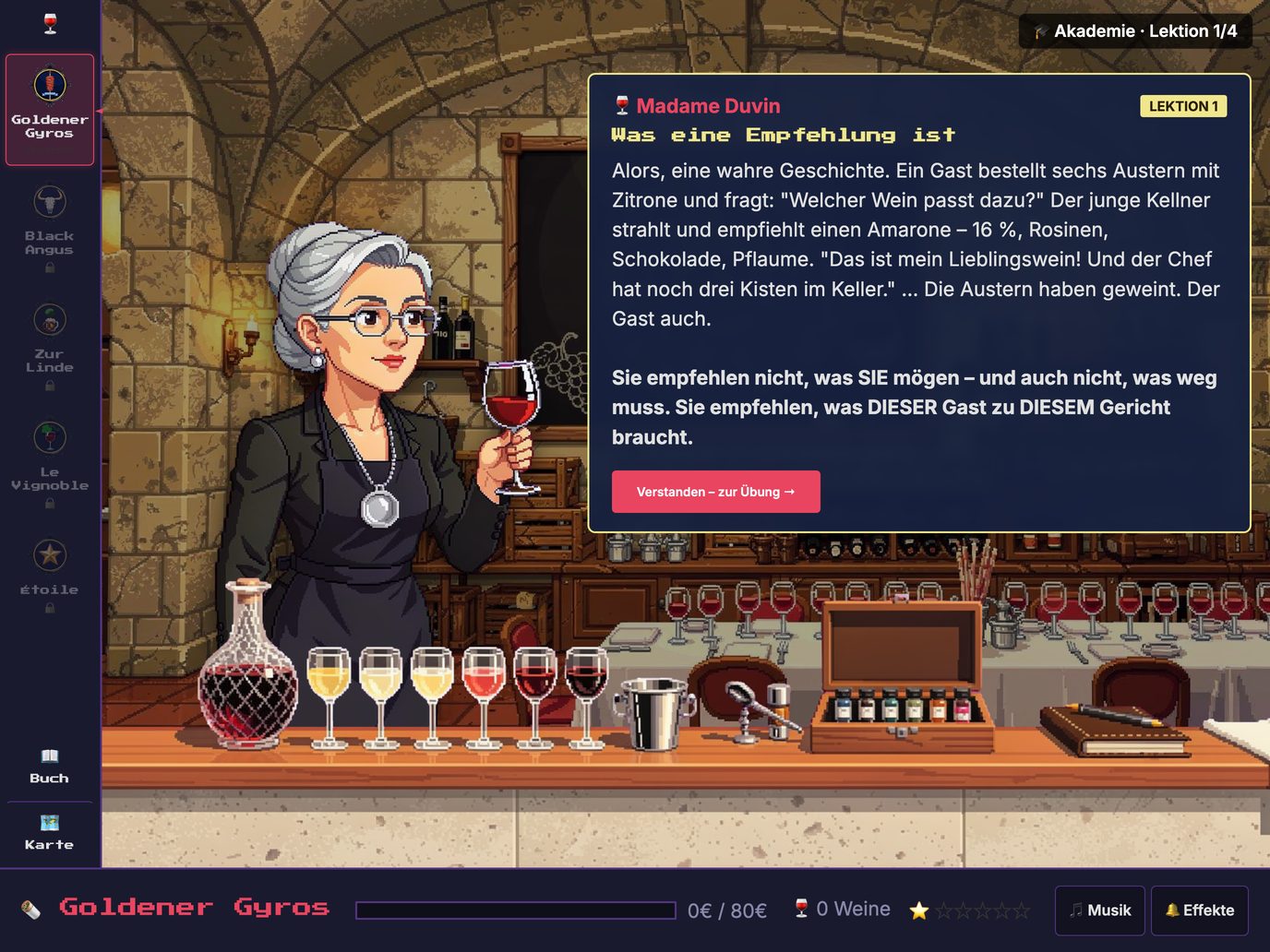
Bevor ein neues Restaurant beginnt, verbringen Spieler einen Tag in der Akademie. Madame Céline Duvin erklärt dort in kurzen Lektionen, was für die nächste Station wichtig ist. Am ersten Tag geht es um Rot, Weiß und Rosé, um trockene und süße Weine und um die Frage, was eine Empfehlung überhaupt ist. Später folgen Rebsorten und Klima, Körper und Tannin, die drei Wege des Food-Pairings, das Beratungsgespräch, Terroir und Ausbau sowie Verkostung und Weinsprache. Before a new restaurant starts, players spend a day at the academy. There, Madame Céline Duvin explains in short lessons what matters for the next stop. The first day covers red, white and rosé, dry and sweet wines, and the question of what a recommendation actually is. Later days cover grape varieties and climate, body and tannin, the three approaches to food pairing, the consultation, terroir and winemaking, and tasting and wine vocabulary.
Zu jeder Lektion gibt es eine Übung. Wer dabei zweimal falsch antwortet, bekommt eine Zusatzübung zum selben Thema mit neuem Inhalt. Insgesamt sind es 23 Lektionen an fünf Akademie-Tagen. Each lesson comes with an exercise. Players who answer wrongly twice get an extra exercise on the same topic with new content. In total there are 23 lessons on five academy days.
Ein Schwerpunkt der Akademie liegt auf Weinen, die nicht im Spiel vorkommen. In mehreren Übungen zeigt Madame Duvin ein frei erfundenes Etikett und fragt, was man daraus über den Wein ablesen kann, etwa aus Rebsorte, Herkunft, Prädikat oder Alkoholgehalt. Am vierten Akademie-Tag lernen Spieler außerdem die Einordnungs-Methode: Ein unbekannter Wein wird über einen Steckbrief aus Farbe, Süße, Körper, Säure, Tannin und Aromafamilie eingeschätzt, wobei Rebsorte, Herkunft und Etikett die nötigen Hinweise liefern. One focus of the academy is wines that do not appear in the game. In several exercises Madame Duvin shows a fictional label and asks what it reveals about the wine, for example from the grape variety, origin, Prädikat or alcohol content. On the fourth academy day players also learn the classification method (Einordnungs-Methode): an unfamiliar wine is assessed with a profile of color, sweetness, body, acidity, tannin and aroma family, with grape variety, origin and label providing the clues.
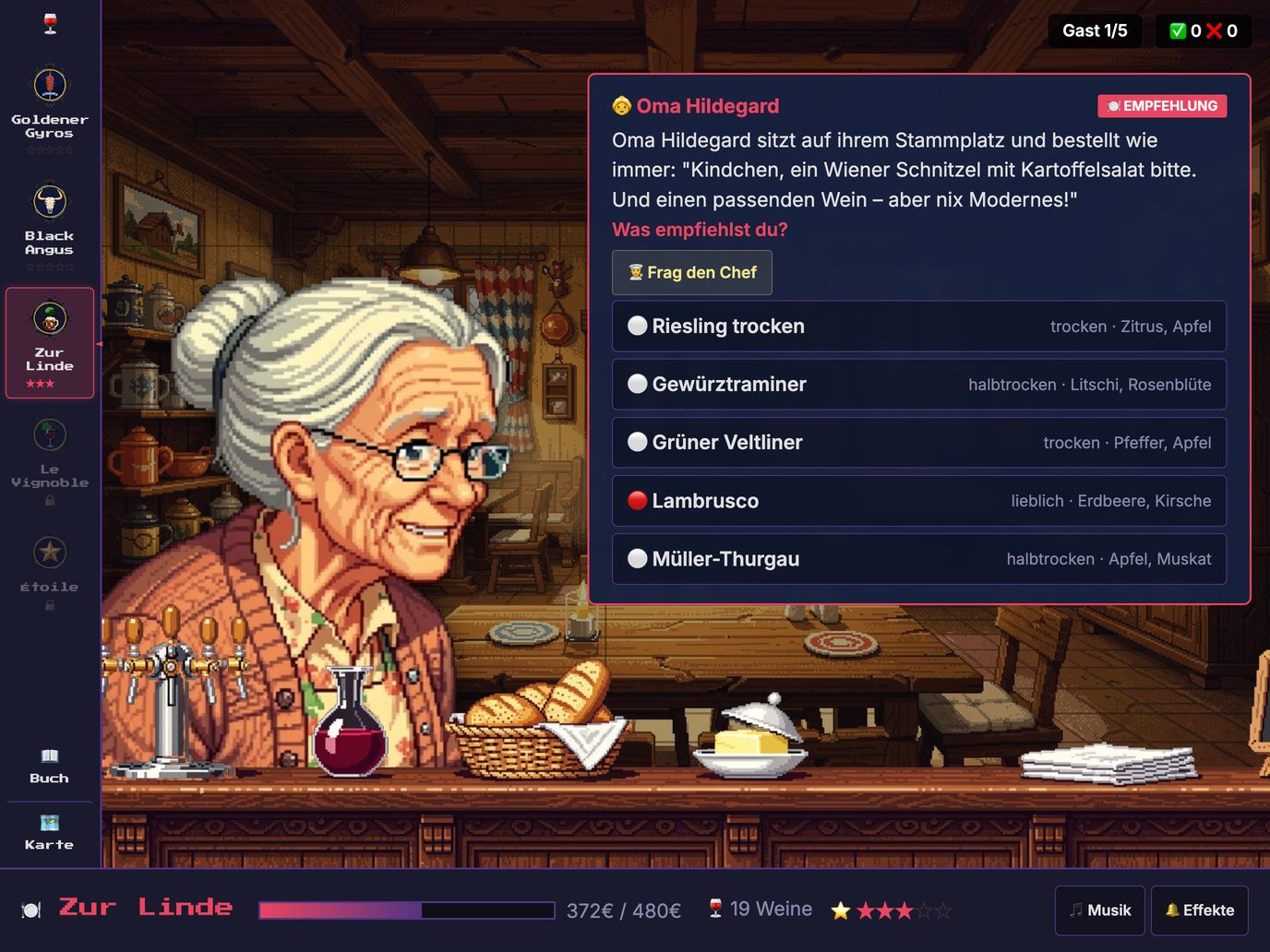
Weine kennenlernen, Gäste beraten, aufsteigen.Get to know the wines, advise guests, move up.
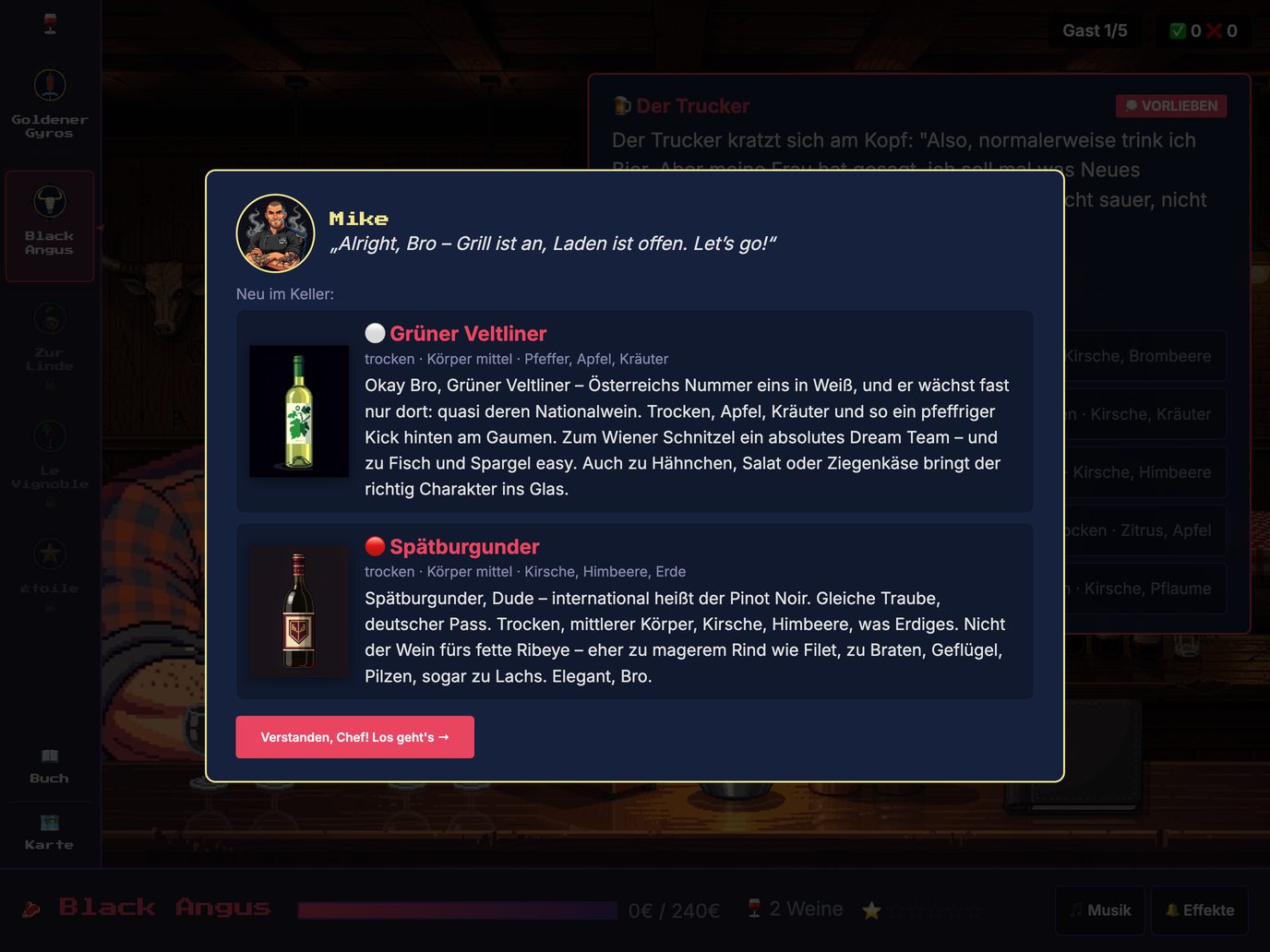
Vor den ersten drei Schichten in jedem Restaurant stellt der Chef zwei bis drei neue Weine aus seinem Keller vor, jeweils mit Geschmack, passenden Gerichten und einer kurzen Geschichte. In der Schicht kommen nur Fragen zu Weinen vor, die bereits vorgestellt wurden oder aus früheren Restaurants bekannt sind. Before the first three shifts in each restaurant, the chef introduces two or three new wines from the cellar, each with its taste, matching dishes and a short story. During the shift, questions only cover wines that have already been introduced or are known from earlier restaurants.
In jeder Schicht kommen fünf Gäste. Eine der Fragen ist immer ein Beratungsgespräch. Ab dem zweiten Restaurant kehrt außerdem in jeder Schicht ein Gast aus einem früheren Restaurant zurück; bevorzugt kommen dabei Fragen, die zuvor falsch beantwortet wurden. Wer unsicher ist, kann den Chef um Hilfe bitten. Er gibt dann einen Hinweis oder streicht eine falsche Antwort, und das Trinkgeld für diese Frage halbiert sich. Each shift brings five guests. One of the questions is always a consultation. From the second restaurant on, every shift also brings back a guest from an earlier restaurant, preferably with a question that was answered wrongly before. Players who are unsure can ask the chef for help. The chef then gives a hint or removes a wrong answer, and the tip for that question is halved.
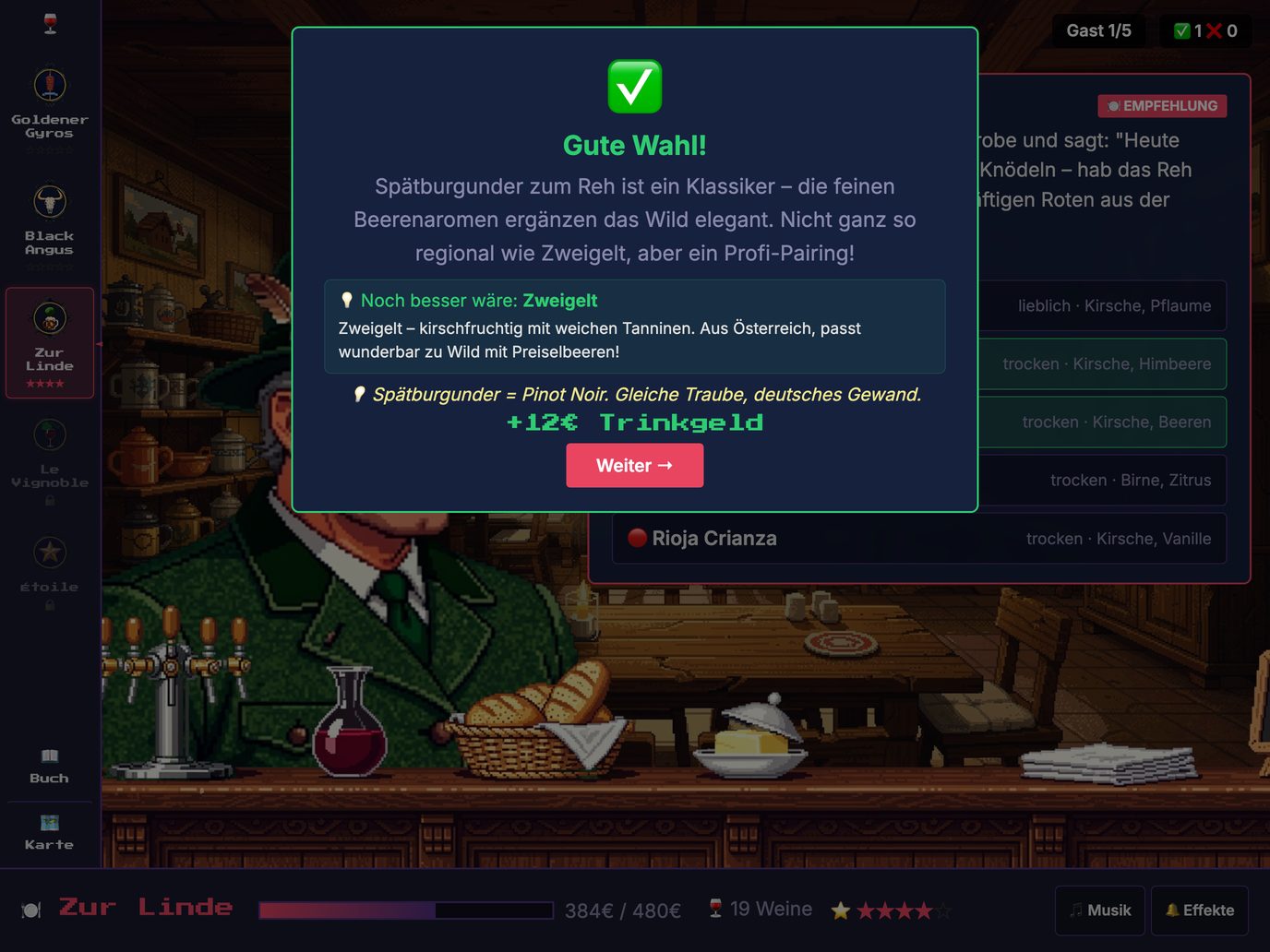
Für eine richtige Empfehlung gibt es Trinkgeld, für die beste Wahl einen Bonus. Eine Antwort, die vertretbar, aber nicht ideal ist, bringt etwa ein Drittel. Für falsche Antworten gibt es kein Trinkgeld. Je höher das Restaurant, desto höher fällt das Trinkgeld aus. Ist das Trinkgeld-Ziel eines Restaurants erreicht, wird das nächste freigeschaltet. Wer etwa 80 Prozent richtig beantwortet, braucht dafür ungefähr drei Schichten. Zusätzlich sammelt der Spieler in jedem Restaurant Ruf beim Chef, der als Sterne angezeigt wird. A correct recommendation earns a tip, and the best choice earns a bonus. An answer that is acceptable but not ideal earns about a third. Wrong answers earn no tip. The higher the restaurant, the larger the tips. Once a restaurant's tip target is reached, the next one is unlocked. Players who answer about 80 percent correctly need roughly three shifts for this. In each restaurant players also build a reputation with the chef, shown as stars.
Das Weinbuch dient als Nachschlagewerk. Es enthält zu jedem bekannten Wein eine Karte mit Rebsorte, Geschmacksprofil, Aromen, passenden Gerichten und einem Fun Fact. Die zoombare Weltkarte zeigt die freigeschalteten Weinländer mit Informationen zur Weinkultur, zu typischen Rebsorten und zu den Qualitätssystemen. The wine book serves as a reference. It contains a card for every known wine with grape variety, flavor profile, aromas, matching dishes and a fun fact. The zoomable world map shows the unlocked wine countries with information on wine culture, typical grape varieties and quality systems.
Sechs Aufgabenformate mit insgesamt 257 Fragen.Six task formats with 257 questions in total.
| FragetypQuestion type | AufgabeTask | AnzahlCount |
|---|---|---|
| EmpfehlungRecommendation | Ein Gast bestellt ein Gericht und fragt nach dem passenden Wein.A guest orders a dish and asks for the matching wine. | 56 |
| VorliebenPreferences | Ein Gast beschreibt ungefähr, was er mag.A guest roughly describes what they like. | 48 |
| Besserwisser | Ein Gast behauptet etwas über Wein. Stimmt das?A guest makes a claim about wine. Is it true? | 57 |
| WeinwissenWine knowledge | Fachfragen zu Rebsorten, Regionen, Herstellung und Qualitätsstufen.Expert questions on grape varieties, regions, winemaking and quality tiers. | 52 |
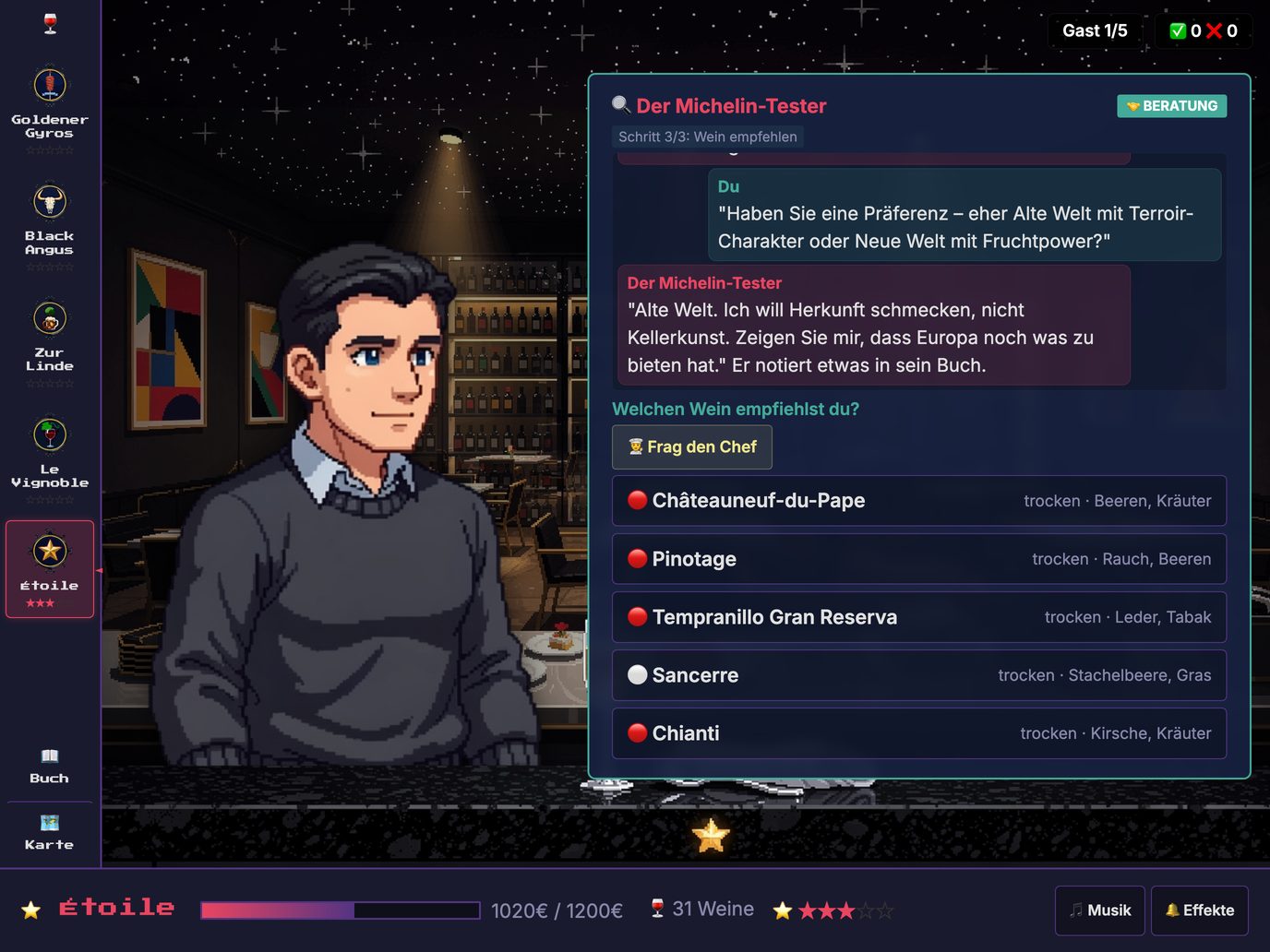
| BeratungConsultation | Ein Gespräch in drei Schritten: nachfragen, zuhören, empfehlen. Eine Beratung pro Schicht.A conversation in three steps: ask, listen, recommend. One consultation per shift. | 28 |
| Blindtasting | Einen Wein anhand von Farbe, Nase und Gaumen erkennen (ab dem Steakhaus).Identify a wine by its color, nose and palate (from the steakhouse on). | 16 |
Die Fragen werden so ausgewählt, dass noch nicht gesehene Fragen zuerst kommen, danach zuvor falsch beantwortete und zuletzt bereits gesehene. Pro Schicht erscheinen höchstens zwei Fragen desselben Typs. Nach jeder Antwort zeigt das Feedback, warum die Wahl passt oder nicht passt. War die Antwort richtig, aber nicht ideal, nennt das Spiel zusätzlich die beste Wahl. Questions are selected so that unseen questions come first, followed by previously wrong answers and finally questions already seen. A shift contains at most two questions of the same type. After every answer the feedback explains why the choice fits or does not fit. If the answer was correct but not ideal, the game also names the best choice.
Vom Imbiss zum Sterne-Restaurant, jedes mit eigenem Schwerpunkt.From snack bar to fine dining, each with its own focus.
| Level | Restaurant | SchwerpunktFocus | Neue LänderNew countries |
|---|---|---|---|
| 0 | Imbiss „Zum Goldenen Gyros“ | Basics & WeinstileBasics & wine styles | DE, IT, GR |
| 1 | Steakhaus „Black Angus“ | Rebsorten & CharakterGrape varieties & character | AT, FR |
| 2 | Gasthaus „Zur Linde“ | Wein & EssenWine & food | ES, PT |
| 3 | Restaurant „Le Vignoble“ | Terroir & WeinbereitungTerroir & winemaking | AR, ZA |
| 4 | Sterne-Restaurant „Étoile“ | Verkostung & WeinspracheTasting & wine vocabulary | keinenone |
Jedes Restaurant hat einen eigenen Küchenchef: Kostas im Imbiss, Mike im Steakhaus, Frau Lindner im Gasthaus, Monsieur Laurent im Le Vignoble und Chef Beaumont im Étoile. Zu jedem Restaurant gehört außerdem ein eigener Radiosender mit passender Musik. Each restaurant has its own head chef: Kostas at the snack bar, Mike at the steakhouse, Frau Lindner at the inn, Monsieur Laurent at Le Vignoble and Chef Beaumont at Étoile. Each restaurant also has its own radio station with matching music.
Ist im Étoile das letzte Trinkgeld-Ziel erreicht, kommt der Michelin-Tester an Tisch 7. Er bestellt ein Menü mit sieben Gängen, und zu jedem Gang stellt er eine Frage. Die Fragen stammen aus allen fünf Restaurants: je eine aus Imbiss, Steakhaus und Gasthaus, je zwei aus Le Vignoble und Étoile. Der Chef hilft dabei nicht. Bestanden ist die Prüfung mit mindestens fünf richtigen Antworten. Once the last tip target at Étoile is reached, the Michelin inspector arrives at table 7. He orders a seven-course menu and asks one question per course. The questions come from all five restaurants: one each from the snack bar, steakhouse and inn, two each from Le Vignoble and Étoile. The chef does not help here. The exam is passed with at least five correct answers.
Nach der bestandenen Prüfung folgt ein Abspann mit Parallax-Effekt, der an den fünf Restaurants vorbeiführt. Danach zeigt eine Bestenliste im Stil alter Spielhallenautomaten die Punktzahl, die sich aus Trefferquote, besten Wahlen, Trinkgeld und Prüfungsversuchen ergibt. Die Bestenliste wird nur auf dem eigenen Gerät gespeichert. After passing the exam, a parallax credits sequence moves past the five restaurants. A high score table in the style of old arcade machines then shows the score, which is based on accuracy, best choices, tips and exam attempts. The high score table is stored only on the player's own device.
Im Steakhaus ist außerdem ein kleines Minispiel versteckt. There is also a small minigame hidden in the steakhouse.
Das Spiel deckt die folgenden Themenbereiche ab, die sich schrittweise über die fünf Restaurants aufbauen: The game covers the following topic areas, which build up step by step across the five restaurants:
31 Weine von Dornfelder bis Champagner mit Farbe, Körper, Süßegrad, Aromen und typischen Einsatzgebieten.31 wines from Dornfelder to Champagne with color, body, sweetness, flavors and typical use cases.
Welcher Wein passt zu welchem Gericht? Die Akademie erklärt drei Wege: ergänzen, kontrastieren und regional kombinieren.Which wine goes with which dish? The academy explains three approaches: complementing, contrasting and regional pairing.
Die richtigen Fragen stellen, Wünsche des Gastes ernst nehmen und eine begründete Empfehlung geben.Asking the right questions, taking the guest's wishes seriously and giving a well-founded recommendation.
9 Länder mit Anbaugebieten und Qualitätssystemen (zum Beispiel DOCG, AOC, Prädikatswein) sowie das Lesen von Etiketten.9 countries with growing areas and quality systems (for example DOCG, AOC, Prädikatswein) and how to read labels.
Auge, Nase und Gaumen, Weinsprache und ab dem Steakhaus Blindtasting.Eye, nose and palate, wine vocabulary and, from the steakhouse on, blind tasting.
Klima, Boden, Stahltank und Holzfass, Reifung und malolaktische Gärung.Climate, soil, steel tank and oak barrel, ageing and malolactic fermentation.
Begleitheft für Lehrkräfte (PDF):Teacher's guide (PDF, German): Ein Begleitkommentar mit Lehrplanbezug und Vorschlag für eine Unterrichtseinheit, dazu für jedes Restaurant den Akademie-Tag, Beispiele, die Weine und Gesprächsimpulse. A commentary with curriculum references and a suggested lesson, plus the academy day, examples, wines and discussion prompts for each restaurant.
Didaktisches Prinzip:Didactic principle: Neues Wissen wird zuerst in der Akademie und durch den Chef eingeführt und erst danach in den Schichten abgefragt. Falsch beantwortete Fragen erscheinen bevorzugt wieder, und ab dem zweiten Restaurant wiederholt jede Schicht eine Frage aus einem früheren Restaurant. So wird gezielt das Wissen gefestigt, das noch unsicher ist. New knowledge is first introduced at the academy and by the chef and only then tested during shifts. Wrongly answered questions are shown again preferentially, and from the second restaurant on every shift repeats a question from an earlier restaurant. This specifically strengthens knowledge that is still uncertain.
| EigenschaftProperty | WertValue |
|---|---|
| TechnologieTechnology | HTML5, CSS3, Vanilla JavaScript |
| PlattformenPlatforms | Browser; iPad-App (Capacitor), bald im App StoreBrowser; iPad app (Capacitor), coming soon to the App Store |
| AbhängigkeitenDependencies | Keine im Spiel selbst; Capacitor nur für die iPad-AppNone in the game itself; Capacitor only for the iPad app |
| FormatFormat | 1920 × 1440, 4:3 (für das iPad ausgelegt, skaliert automatischdesigned for iPad, scales automatically) |
| TonSound | Musik-Radio pro Restaurant (Titel von Pixabay) und Soundeffekte, beides abschaltbarMusic radio per restaurant (tracks from Pixabay) and sound effects, both can be switched off |
| SpeicherungStorage | Spielstand und Bestenliste nur lokal auf dem GerätSave game and high scores stored locally on the device only |
| DatenschutzPrivacy | Kein Konto, keine Werbung, keine Datenerhebung (Datenschutzerklärung)No account, no ads, no data collection (privacy policy) |
| LizenzLicense | CC BY 4.0 (Namensnennung; die Musik ist ausgenommenAttribution; the music is excluded) |
Das Spiel ist als begleitendes Material gedacht. Die fünf Restaurants stehen für fünf Schwerpunkte und lassen sich einzeln als kurzer Impuls in Lernfelder einbinden, die ohnehin Beratung, Getränke oder Menüs behandeln, vor allem LF 5, LF 7 und LF 11. Eine Einheit besteht aus einer Spielphase von 20 bis 30 Minuten und einem anschließenden Gespräch. Mit den Levelcodes startet das Spiel direkt im passenden Restaurant. Lehrplanbezug, Ablaufvorschlag und Gesprächsimpulse stehen im Begleitheft für Lehrkräfte. The game is meant as accompanying material. The five restaurants stand for five focus topics and can each be used as a short impulse within learning fields that already deal with advice, beverages or menus. A unit consists of a 20 to 30 minute play phase followed by a discussion. Level codes start the game directly in the matching restaurant. Curriculum references, a lesson outline and discussion prompts are in the teacher's guide (German).
python3 -m http.server).
Download the files and start them with a simple local server
(python3 -m http.server).
Im App Store ist die iPad-App ab 18 Jahren freigegeben. Apple berechnet die Altersstufe aus einem Fragebogen, und weil Wein das Thema des Spiels ist, ergibt die Antwort „häufige Bezüge zu Alkohol“ automatisch die Stufe 18+. Eine Zwischenstufe für Alkohol, etwa ab 16, sieht das System nicht vor. On the App Store, the iPad app is rated 18+. Apple calculates the rating from a questionnaire, and since wine is the subject of the game, the answer “frequent references to alcohol” automatically results in 18+. The system has no intermediate level for alcohol, such as 16+.
Inhaltlich ist „Der Sommelier“ Lernmaterial für die Ausbildung in Gastronomie und Service. Getrunken wird nur am Rand, etwa wenn ein Gast den empfohlenen Wein probiert; Betrunkene kommen nicht vor. Das Spiel wirbt nicht für Alkohol und verkauft keinen. Es vermittelt Fachwissen, das Auszubildende für die Beratung von Gästen brauchen. Nach dem Jugendschutzgesetz dürfen Wein und Bier an Jugendliche ab 16 Jahren abgegeben werden (§ 9 JuSchG), und viele Auszubildende beginnen ihre Ausbildung in diesem Alter. In terms of content, “Der Sommelier” is learning material for vocational training in hospitality and service. Drinking only happens in passing, for example when a guest tastes the recommended wine; nobody is shown drunk. The game neither advertises nor sells alcohol. It teaches the knowledge trainees need to advise guests. Under German youth protection law, wine and beer may be sold to young people from the age of 16 (§ 9 JuSchG), and many trainees start their apprenticeship at that age.
Die Altersgrenze im App Store greift nur auf Geräten mit aktiven Inhaltsbeschränkungen, zum Beispiel bei Kinder- und Jugendkonten in der Familienfreigabe oder auf verwalteten Schul-iPads. Für Auszubildende unter 18 und für den Unterricht steht die Browserversion ohne Altersgrenze zur Verfügung; sie hat denselben Inhalt wie die App. The App Store age limit only applies on devices with active content restrictions, for example child and teen accounts in Family Sharing or managed school iPads. For trainees under 18 and for classroom use, the browser version is available without an age limit; it has the same content as the app.